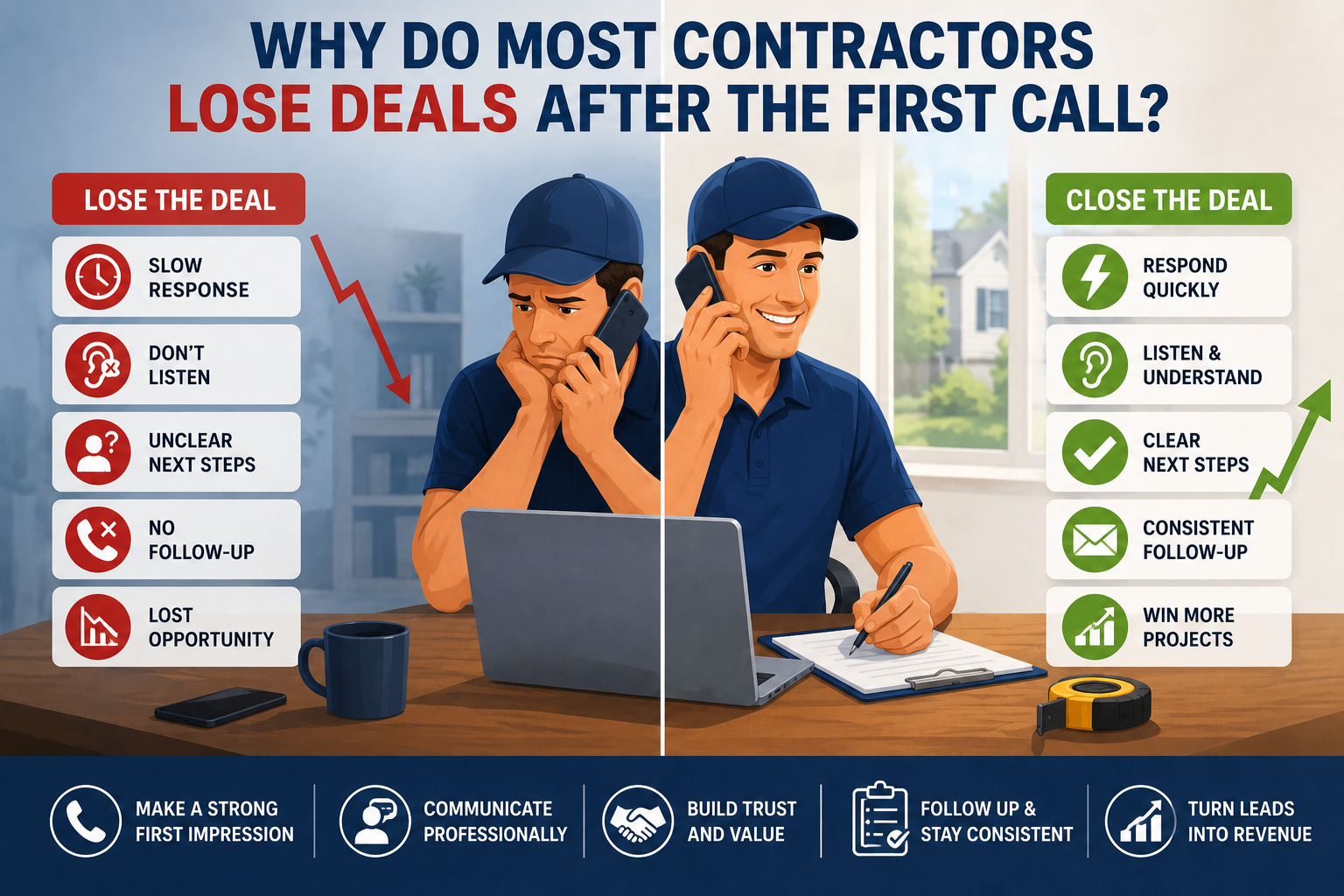
Getting the phone to ring is only half of the picture when you’re in the contracting business.
A lot of contractors pour money into marketing, websites, and ads just to bring in fresh inquiries, sometimes pretty heavily. But even when the leads keep coming, they still seem to stall out. Like, the opportunities arrive, yet they struggle to turn that momentum into actual paying customers.
Honestly, the reality is that a lot of businesses don’t really lose the job because of bad workmanship or mispricing. It’s more like they lose the project because of what takes place, or doesn’t take place, after that very first conversation.
Understanding why contractors lose deals after the first call is essential for improving conversion rates and maximizing the return on every lead generated. Even small adjustments to your communication process can significantly impact your bottom line.
The First Call Sets the Tone
For potential customers, the first phone call is more than just an inquiry, like it’s not only a “hello.” It is often their first impression of your company.
Homeowners reaching out for roofing, remodeling, plumbing, or electrical services are usually getting in touch with several businesses at once. They’re trying to figure out, pretty quickly, whether you are professional, dependable, and able to resolve their issue, or at least handle it with care.
Unfortunately, many contractors unintentionally create a negative experience during this initial interaction by:
- Taking too long to answer.
- Sounding rushed or distracted.
- Failing to ask questions.
- Providing vague information.
- Neglecting to follow up.
When this happens, prospects quickly move on to the next contractor on their list.
Slow Response Times Kill Opportunities
Speed Matters
Studies keep showing that companies that respond to questions quickly usually have much better odds of turning those leads into actual customers. When a homeowner submits a form or leaves a voicemail, it feels like an immediate situation for them.
A dripping roof, a faulty HVAC setup, or a remodeling job gives off this real urgency; thus, if your business sits on it for a few hours, or worse, through the whole day, another contractor is probably already fitting that estimate into their calendar.
One of the main reasons contractors lose the deal after that first conversation is pretty straightforward: they just don’t answer fast enough.
Building a workflow that makes sure every prospect gets a timely reply can boost your conversion rate in a major way. This may involve:
- Using call forwarding systems.
- Assigning staff to monitor inquiries.
- Implementing automated responses.
- Scheduling follow-up reminders.
The faster you engage a prospect, the higher your chances of securing the project.
Contractors Talk More Than They Listen
Lots of contractors fall into the trap of seeing that first call as just a sales pitch thing. Rather than taking in what the homeowner is really worried about, they go straight into talking about services, their pricing, or even the company background. Sure, that sort of detail matters, but customers above all want to feel listened to, like their concerns are actually receiving attention.
The first conversation should focus on understanding:
- What problem needs to be solved?
- How urgent is the issue?
- What outcomes does the customer expect?
- What concerns do they have about hiring a contractor?
Active listening helps build trust, and it shows professionalism. It often gives you valuable info that allows you to craft more personalized solutions, not just generic ones.
Also, customers are more likely to hire contractors who actually understand their needs rather than people who merely try to sell their services.
Lack of Professionalism Creates Doubt
Homeowners tend to judge how reliable a contractor feels by the quality of their communications; it’s not always just the finished work. Even if the workmanship is top-notch, a communication gap can leave you in an odd uncertainty, and it never seems to sit right.
Some common mistakes include:
- Interrupting customers.
- Using excessive industry jargon.
- Sounding disorganized.
- Being late to return calls.
- Forgetting details discussed during the conversation.
These behaviors may seem minor, but they can lead customers to question how you handle projects overall.
Professional communication doesn’t really need a scripted sales approach. It’s more about being attentive, being courteous, and staying organized, even when things get a little busy.
Simple practices like confirming details, taking notes, and outlining clear next steps can make a strong impression.
Failure to Establish Value
Many contractors immediately start talking about pricing on that first call, not knowing that while customers do care about cost, they also want to know what kind of value they’ll be getting.
If price is your unique angle, then you’re probably caught in some race to the bottom, where everybody is trying to undercut everyone else.
Successful contractors use the first call to communicate:
- Years of experience.
- Licensing and certifications.
- Specialized expertise.
- Customer service standards.
- Warranties and guarantees.
- Project management processes.
When customers understand your value, they become less focused on only going for the cheapest estimate.
One major reason contractors lose deals after first call is their inability to explain why they are the best fit for the job.
No Clear Next Step
Many conversations end without a clear action plan, leaving customers hanging.
A lot commonly sounds like “We’ll get back to you” or “Someone from our office will call.” Or even, “Check our website and let us know.”
But those vague responses create a lot of uncertainty and somehow make it easier for prospects to keep shopping around.
Every first call should end with a specific next step, not just a promise.
Examples include:
- Scheduling an in-home estimate.
- Booking a site inspection.
- Sending a written proposal.
- Confirming a follow-up appointment.
Clear expectations help the whole momentum keep going, and they lower the chances of losing the opportunity.
Lack of Consistent Follow-Up
Many contractors think that if a prospect is interested, they’ll call back. Sadly, this is rarely how consumers do it nowadays, or at least not consistently.
Homeowners are busy, and their focus can shift quickly, sometimes in a day. Genuinely interested prospects may forget to respond if there’s no follow-up or if no one ever nudges the conversation forward.
Effective follow-up strategies include:
- Sending a confirmation email.
- Providing appointment reminders.
- Following up after estimates.
- Checking in after sending proposals.
- Answering additional questions promptly.
You’ll notice that some of the most successful contractors earn extra revenue just because they keep following up consistently, while other competitors don’t. Persistence, without being pushy, actually shows professionalism and keeps your business top of mind.
Poor Lead Quality Can Also Be a Factor
Sometimes, losing deals isn’t all about sales performance, but usually the lead quality makes a big difference.
If you’re getting inquiries from homeowners outside your service area, people asking for unrealistic pricing, or prospects who seem unsure, your close rate will, pretty naturally, take a hit. That’s where working with a trustworthy contractor leads service provider can put you in a better position.
Better lead generation services focus on sending more suitable inquiries from homeowners who are actually looking for the service right now and who are more likely to convert into real customers.
A reliable contractor leads service can help contractors:
- Reach qualified prospects.
- Reduce time spent on unproductive inquiries.
- Improve conversion rates.
- Increase marketing efficiency.
- Generate a more consistent pipeline of opportunities.
However, even the best leads can be lost if your follow-up process is weak.
Turn More First Calls Into Paying Customers With the Right Partner
Getting quality leads is important; however, turning them into booked work still really depends on keeping a consistent approach and choosing the right kinds of opportunities.
With HomeGuru, we link contractors to homeowners who are actively looking for reliable pros for all sorts of home improvement projects, not just random “maybes.”
Our lead generation approach is built so you’re not wasting hours pursuing unqualified requests, and instead, you can spend more time doing the relationship part that actually turns into income.
Start receiving solid lead flow that turns into booked projects and keeps customers coming back for the next job, as HomeGuru can help you uncover stronger leads and make every first call count, every time.