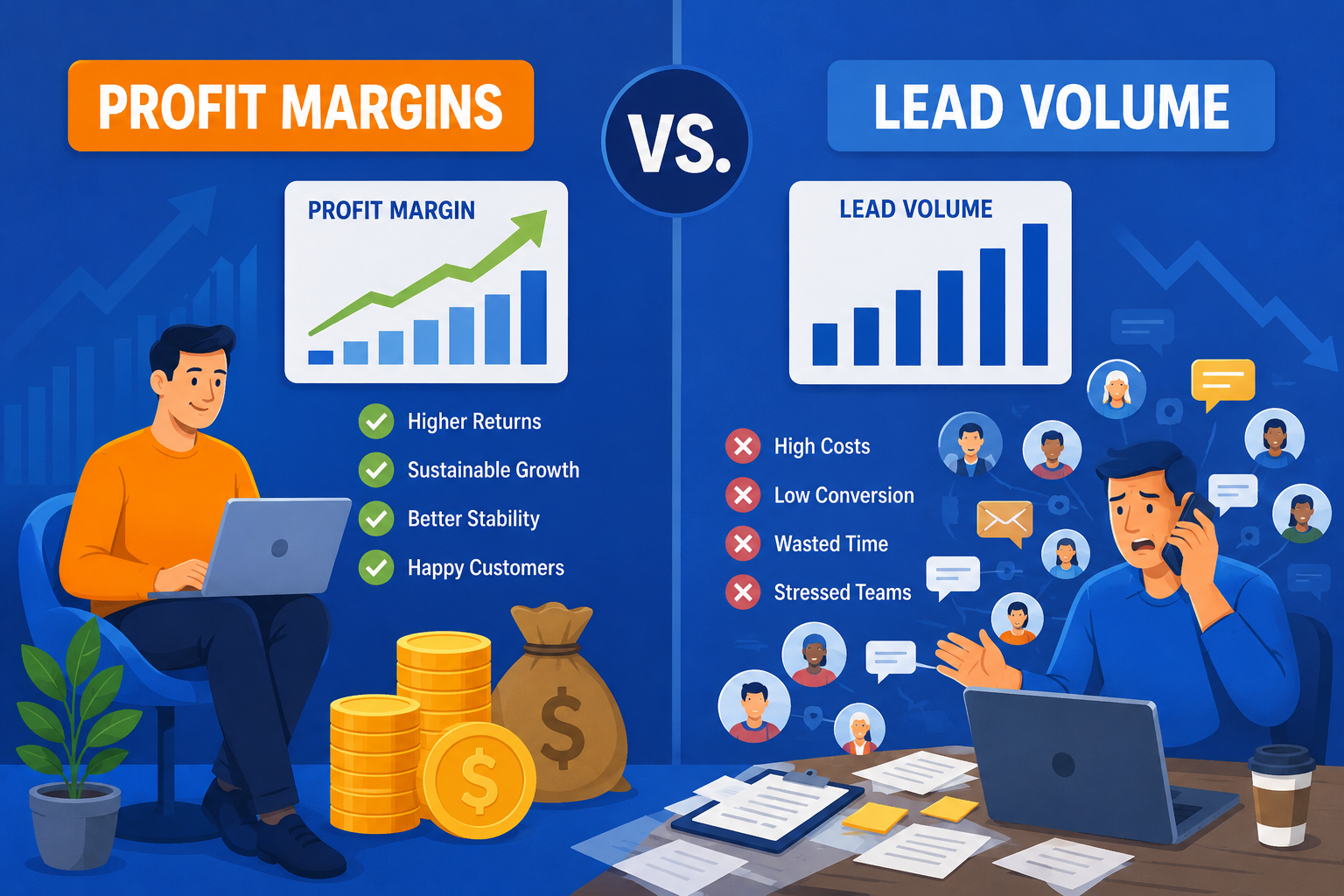
In sales and marketing, companies tend to focus on generating as many leads as possible. More leads usually sound like more openings, right?
But even if lead volume climbs, it does not automatically mean stronger profits. In many situations, organizations that emphasize solid profit margins rather than sheer lead volume tend to achieve steadier results over time.
Getting the right balance between profit margins and how many leads you generate really matters for long-term growth.
Whether you run home services, real estate, insurance, or you’re doing digital marketing, it helps to understand which number deserves priority. That way, we can make sharper business choices instead of guessing.
Understanding Profit Margins and Lead Volume
Before you decide what matters more, it helps to pin down both ideas, step by step.
What Is Lead Volume?
Lead volume is basically the count of potential customers that come into your sales pipeline. Most companies try to boost lead volume by using ads, SEO, social networks, email marketing, and also collaborations or partnerships.
A high lead volume can:
- Increase brand visibility.
- Create more sales opportunities.
- Expand customer reach.
- Improve market presence.
However, not all leads are made the same; some are more useful than others. If leads are not really qualified, or they seem flatly uninterested, then your sales team may end up wasting precious time chasing prospects that don’t convert much.
What Are Profit Margins?
Profit margin measures how much money your business ends up keeping once expenses are subtracted from revenue. If the profit margins look strong, that usually means your business is operating in a fairly efficient way, and it is also producing solid returns for you.
Businesses with higher profit margins can:
- Reinvest in growth.
- Handle economic downturns better.
- Improve operational stability.
- Increase long-term sustainability.
When comparing profit margins and lead volume, the key question becomes whether it is better to have many low-quality leads or fewer highly profitable customers.
The Problem With Chasing Lead Volume Alone
Many companies tend to end up in this trap, where they focus on lead quantity before pretty much everything else.
Even if a large number of leads look dazzling in reports, it can bring several hidden problems, like the whole funnel feeling noisy and less controlled.
Increased Marketing Costs
Generating high lead volume usually means spending quite a lot on ads, and it can get expensive fast.
Businesses commonly pour money into pay-per-click campaigns, social media promotions, and those third-party lead providers, just to keep the pipeline fed. If conversion rates stay low, acquisition expenses can quickly nibble away at profits.
For instance, a company that pulls in 1,000 leads each month may look successful at first glance, but only 2% convert, and customer acquisition costs are high. Then, overall profitability can take a hit.
Lower Lead Quality
High-volume lead generation strategies sometimes prioritize quantity over intent. This can result in:
- Unqualified prospects.
- Time-wasting inquiries.
- Lower close rates.
- Higher customer acquisition costs.
Sales teams become overwhelmed managing leads that are unlikely to convert.
Team Burnout
An excessive focus on lead quantity can create unnecessary pressure on marketing and sales departments, and it makes things feel a bit frantic.
Teams may end up spending more time sifting through weaker leads rather than doing the actual relationship-building with qualified prospects.
Sometimes it’s like they are always sorting instead of connecting, and that can slow everything down. This inefficiency can reduce productivity and hurt employee morale.
Why Do Profit Margins Often Matter More?
While lead volume is important, profit margins usually give a clearer look at business health. A company that keeps up strong margins over time is often more stable than another one that depends just on high lead counts.
And yes, even if you see big numbers at first, margins are kind of the real indicator, not just volume.
Sustainable Growth
Healthy profit margins allow businesses to scale strategically. Companies with strong profitability can:
- Invest in better tools and technology.
- Hire skilled employees.
- Improve customer service.
- Expand operations carefully.
Without profitability, even businesses with massive lead pipelines can struggle financially.
Better Customer Relationships
Businesses that focus on profitability usually aim for ideal customers, not just on pushing the numbers.
It’s more about the right crowd, a kind of targeted fit rather than pure quantity, and even if the wording sounds similar, the intention is a little different. This approach encourages:
- Better service quality.
- Stronger customer retention.
- Higher customer lifetime value.
- Improved referrals.
In many industries, repeat customers and referrals generate more revenue than constantly acquiring new leads.
Smarter Resource Allocation
Looking at profit margins helps businesses figure out which marketing channels actually make the most sense and produce the best returns.
Rather than chasing every possible lead source nonstop, companies can put money into strategies that bring in better prospects, with that higher conversion potential more often.
That’s where exclusive live leads tend to become especially useful and hard to replace.
The Value of Exclusive Live Leads
Not every lead brings in the same kind of profit. Companies that choose exclusive live leads tend to see stronger conversion rates, because these exclusive leads aren’t passed around to multiple competitors, so there’s more chance they actually stick.
Prioritize Lead Quality Over Quantity
Instead of focusing solely on increasing numbers, businesses should evaluate the following:
- Conversion rates.
- Customer lifetime value.
- Cost per acquisition.
- Average sale value.
Usually, strong leads generate better long-term profitability than a big pile of low-quality inquiries, or so it feels, because the outcomes tend to stay consistent over time, and the volume alone doesn’t really guarantee anything.
When Does Lead Volume Become More Important?
Although profit margins often take first place, there are times when more lead volume does make sense, at least in certain situations.
Brand Awareness Campaigns
New businesses might start by going for higher lead volume, just to build some visibility and set up a market presence sooner. This approach helps in the beginning, when the goal is basically to get noticed and gain a foothold.
Highly Competitive Markets
In industries with intense competition, keeping a solid pipeline can help companies stay ahead of rivals, even when everything feels like it is moving fast.
However, during aggressive growth phases, businesses really still need to watch profitability closely, so they do not end up spending on unsustainable resources over time.
Why Do the Right Leads Matter More Than the Most Leads?
When looking at profit margins and lead volume, profit margins usually show a more accurate picture of business success.
Lead volume might sound like it helps growth, but without strong profitability, that growth can easily turn into something unsustainable.
Smart companies don’t obsess over lead counts alone. Instead, they aim to create well-qualified opportunities, boost conversion rates, and push customer value higher, sort of like being precise rather than loud. They invest in high-quality exclusive live leads and also tighten up operational efficiency, so revenue growth stays steady along with stronger profit margins.
In the end, the point isn’t just getting more leads; it’s about generating the right leads that actually support long-term profitability and real business success.
Ready to Focus on Leads That Actually Drive Profit?
At HomeGuru, businesses get access to lead generation strategies that are built to drive conversions, boost customer value, and back long-term growth.
Whether you’re hunting exclusive live leads or you want smarter ways to strengthen your sales pipeline, HomeGuru can help you reach the right customers, not just more customers.
Check out how HomeGuru supports your next steps and see how it all connects. Explore how HomeGuru can help today!